Transmitters (2024-present)
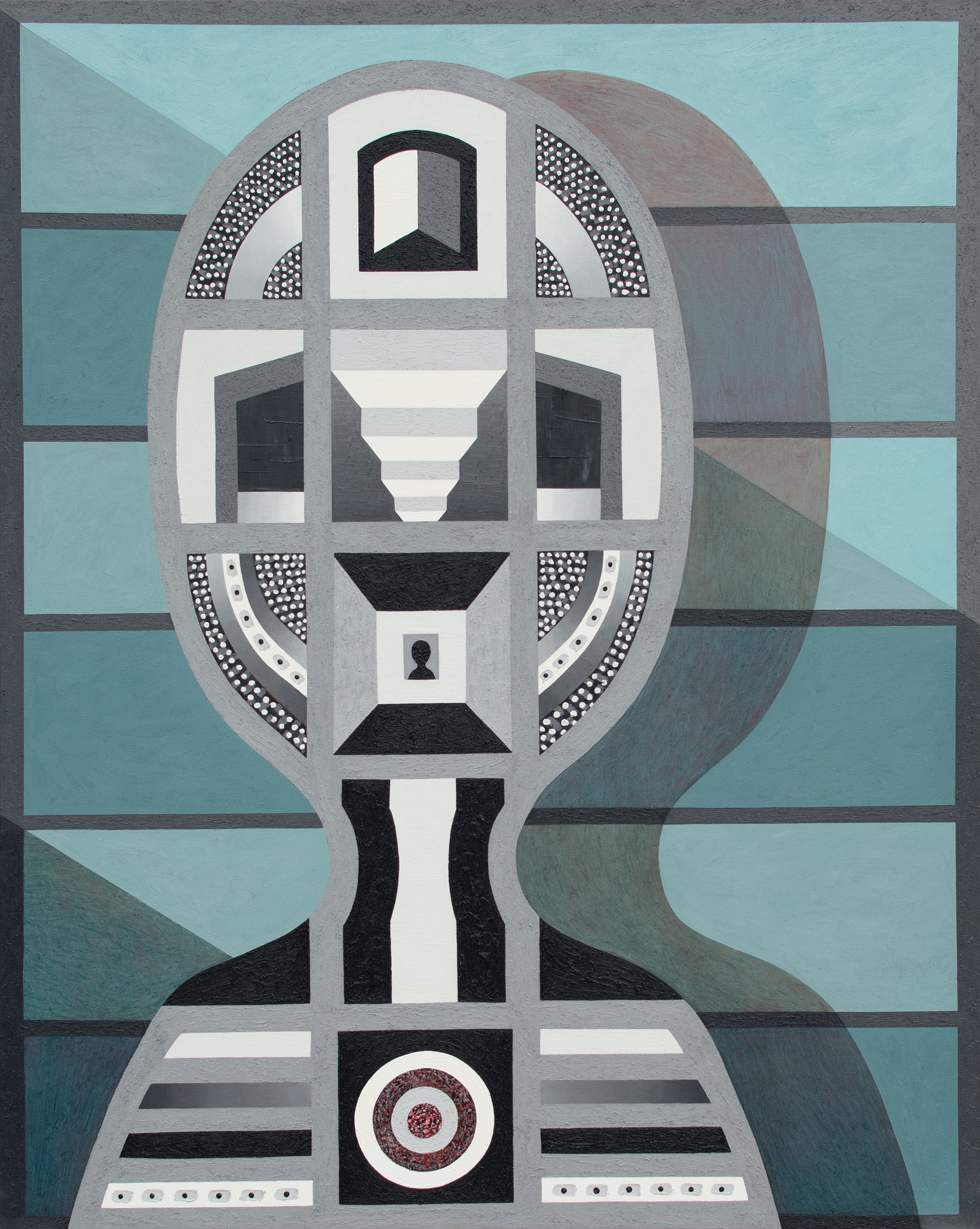
Complicator, (Transmitters Series), 2024
How does one transmit a message across an impenetrable divide? And can the language of painting send such a message when all other forms of communication have been lost? These questions are at the core of this body of work, which investigates a personal experience of suicide bereavement.
This series unknowingly began when I found myself making crude, automatic sketchbook drawings unlike anything I had made before. These sketches offered a private outlet for my grief; a means of giving form to the uncertainties created by this loss and grappling with its unfolding repercussions. Over time, I began to experiment with the possibility of transforming these private transmissions into public-facing paintings that might hold meaning for others. Messy, muddled sketches became flat, geometric forms as I transformed the disarray of the original sketches first into digital compositions and then into large scale paintings whose graphic simplicity was complicated by gestural marks and textures. Populated by simplified human forms that stand in for both those who have gone and those who remain, these paintings seek to give shape to the strangeness that permeates daily life in the aftermath of a loved one’s sudden passing. Like grief itself, the process of making these paintings has been characterized by a series of interwoven contradictions. Private and public, disarray and order, flatness and texture, and absence and presence all speak in equal measure, creating a tension that defines each work. And while this process has not led to resolution, embracing these incongruities has provided a form of comfort in knowing that they can coexist and communicate. My hope is that by engaging with this work, viewers can connect with their own experience of grief, whatever its source may be, and find some small solace in this shared experience.
Onlookers (2021-2023)

Untitled (Onlookers Series), 2023
The Onlookers series employs portraiture to interrogate anxieties, hopes, and uncertainties around the acceleration of technological progress and its future implications. These works were initiated by creating a dataset of hundreds of images of my entire body of work as an artist, as well as ephemera surrounding my creative practice. This dataset was then fed into a machine learning program designed to generate new images consistent with those provided. When used with a massive set of similar source images, such programs can produce convincing artificial images of subjects such as cats or sneakers. However, my unorthodox approach of providing a smaller, more idiosyncratic set of personally linked images, meant to illustrate the arc of an ongoing creative practice, produced highly unusual and irregular interpretations of my work that were at once confounding and strangely familiar. I then took these murky, low-resolution images as a starting point and reimagined them as portrait paintings. The re-introduction of human touch, scrutiny, and materiality have led to a body of paintings that I regard as both a form of uncanny self-portraiture as well as a collaboration (albeit one with a non-human entity). For me, these portraits often read as figures in the distance; presences obscured by layers of misunderstanding but seeking a human connection that remains beyond grasp. Are they entirely new digital life forms? Future human avatars whose bodies have been left behind? Apparitions warning of a dehumanized future? Or are they simply the confused remnants of an intentional misuse of an emerging technology? These and other questions continue to accumulate as each new portrait takes shape.
Interpolators (2018-2020)
The Interpolators series focuses on the process of constructing public persona at a time in which our likenesses have become increasingly malleable, fraught, and self-searching. In these works, signifying objects collide and disperse to build portrait subjects which appear hyper-performative yet exist in a constant state of flux. These objects, symbols, and patterns both attach and remove themselves from the human form at such a dizzying pace that they often seem to evoke unpredictable weather patterns to which the subjects must adapt. This interaction seeks to investigate the inherent contradiction between the increasing pressure for self-branding and presentation with the fluid and ever-changing experience of being a person. Ultimately, I view these works as a depiction of a moment in which the construction of public persona, once a rare and curious phenomenon, is now as ubiquitous, relentless, and mercurial as the weather itself.

Narrator (Interpolators series), 2019
Disintegrants (2016-2018)
During a time in which we are increasingly inundated with mediated images, digital representations and virtual relationships, a sense of disembodiment can emerge. Our physical forms, once the primary source from which our individual identities arose, have begun to feel tangential. We can now construct ourselves in realms that seem no longer determined by our physicality, and in some senses we can transcend our natural abilities and characteristics. This new notion of self-determination can feel at once exhilarating and unnerving.
The works comprising this series seek a form of portraiture that describes the departure of its subjects from their physical entities. Rather than focusing on traditional portrait elements of likeness, anatomy and contextual surroundings, these portraits are concerned with more abstract characteristics such as cognition, motivation and transition. The predominant forms in these works are sourced from abandoned painting stretchers, suggesting an armature that can be both deconstructed and liberated from its previous incarnation. These brightly colored and patterned elements collide and break apart to suggest subjects that correspond to a physical body but are not bound by its limitations. While there is a celebratory component to these forms, their fractured and precarious nature also suggests what self-psychologist Heinz Kohut called “disintegration anxiety,” describing the fear of a cohesive self breaking apart irreversibly. Ultimately, I see these works as neither portraits of our physical forms nor the illusory selves we construct, but rather of the mercurial bodies that exist in between.
Occupants (2012-2015)
We all experience moments in which the roles we play in our daily lives come to define us in powerful ways. In the pursuit of survival, prosperity, leisure, social status, and personal meaning, we often assume identities that both define and fail to define us. My current body of work explores the possibilities and limitations of our daily occupations at a time in which we frequently change jobs, balance multiple roles, and cannot easily delineate between private and public life.
Traditionally, the portrait has sought to convey both the individual characteristics of the sitter and tell us something about their role in society. In particular, the genre of occupational portraiture has described its subjects through the lens of their daily working lives. The portraits in this body of work seek to reinterpret this genre by deemphasizing the sitters’ individual characteristics in order to create images of figures entirely consumed by their given occupations. These works concentrate on tools, uniforms, ephemera, and other signifiers that both define the sitters’ roles and obscure their identifying qualities. Inevitably, despite the attempt to faithfully translate each subject’s position, this unwieldy process of piling on and covering up results in a certain degree of incongruity, perhaps offering a reflection of the rapidly changing nature of our daily roles and practices. I view this body of work as a kind of group portrait; one that is both intensely descriptive and curiously elusive.

Gaze Shifter (Disintegrants series), 2016

Ruralist (Occupants series), 2015